|
|
|
Click
the Ice Cubes for Navigation |
These standards were co-authored by the Alaskan Klee Kai Association of America Board of Directors and approved by the United Kennel Club. The Alaskan Klee Kai were accepted into the UKC with full privileges on January 01, 1997. Official UKC Breed Standard
The goals and purposes of this breed standard include: to
furnish guidelines for breeders who wish to maintain the quality of
their breed and to improve it; to advance this breed to a state of
similarity throughout the world; and to act as a guide for judges.
Breeders and judges have the responsibility to avoid any conditions or
exaggerations that are detrimental to the health, welfare, essence and
soundness of this breed, and must take the responsibility to see that
these are not perpetuated.
The Alaskan Klee Kai was developed in Alaska by Linda Spurlin
and her family, to be a companion-sized version of a type of dog
referred to as the Alaskan Husky. From the early 70’s through 1988, the
Spurlins carefully selected dogs who met their high standards for
appearance and soundness. In 1988, they made the Alaskan Klee Kai
available to others. Mrs. Spurlin originally called her new breed the
“Klee Kai”, but in 1995 it was changed to “Alaskan Klee Kai”.
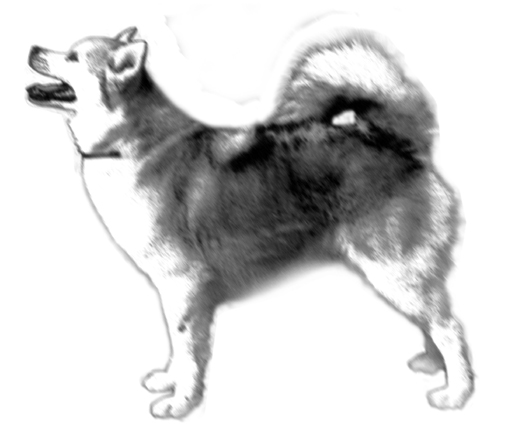
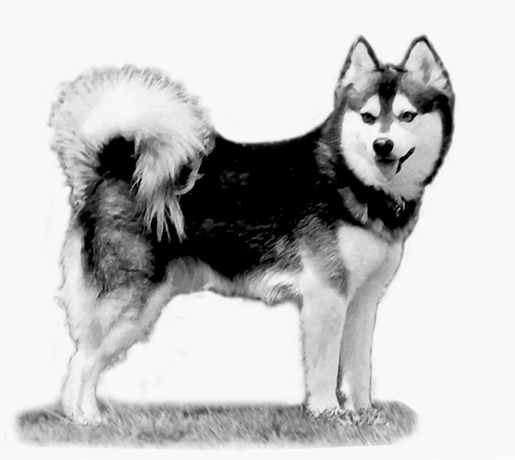
The Alaskan Klee Kai is a small
version of a type of dog referred to as the Alaskan Husky, with a
wedge-shaped head featuring a striking masked face, prick ears, and a
double coat. The length of body is just slightly longer than the
height. The tail is well-furred and curls over the back or to either
side when the dog is alert or moving. The appearance of the Alaskan
Klee Kai reflects the breed’s Northern heritage.
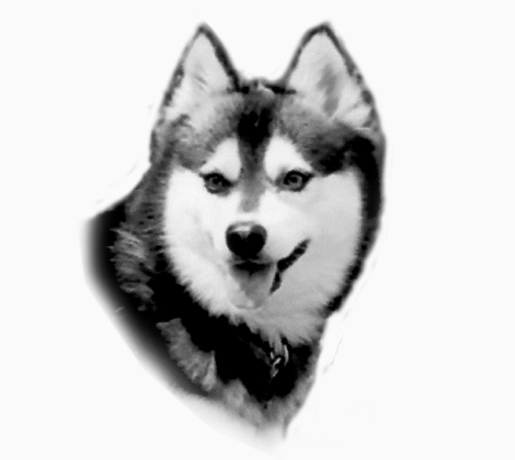
The most distinctive
characteristic of the Alaskan Klee Kai is the facial mask, which must
be clearly visible due to contrasting colors. The full face mask is the
most desirable. The Alaskan Klee Kai is very curious, active, quick and
agile. His loyalty and alertness make the Alaskan Klee Kai an excellent
watchdog, who may be territorial despite his small size. While
affectionate with family members, the Alaskan Klee Kai is reserved and
cautious with strangers and in unfamiliar situations.
The head is clean, free of wrinkles, proportionate to the
size of the body, with a moderate stop. When viewed from the top or
side, the skull and muzzle taper toward the nose to form a broad-based
wedge shape. Faults: Narrow
head; insufficient stop; stop too steep.
SKULL - The skull is slightly
rounded and somewhat broad, tapering gradually from the widest point to
the eyes.
Faults: Skull
too flat or too domed.
MUZZLE - The length of the
muzzle, from stop to nose, is equal to or slightly shorter than the
length of the skull, from occiput to stop. When viewed from the side or
from above, the muzzle tapers slightly from where it joins the skull to
the nose. The muzzle is well-filled-in under the eyes. The lower jaw is
strong, but not protruding. Lips are tightly closed and black, except
that liver-colored lips are acceptable in dogs whose coat colors are
shades of red with white.
Faults: Loosely
hanging lips; a shallow or receding lower jaw; a pinched or snipey
muzzle; a too short or too long muzzle.
TEETH - A full complement of strong white teeth
meet in a scissors bite. Fault: Level
bite.
Disqualifications:
Overshot or undershot bite, wry mouth.
NOSE
- A solid black nose is preferred, although the pink-streaked “snow
nose” is acceptable. A liver-colored nose is acceptable in dogs whose
coat colors are shades of red with white.
In profile, the nose is on the same line as the top of the muzzle and extends just slightly beyond the lower jaw. EYES - The eyes are of medium size and may be any color or combination of colors. Almond-shaped eyes are the most desirable, followed in order of preference by oval and round. The eyes are set obliquely. Eye rims are black except that liver eye rims are acceptable in dogs whose coat colors are shades of red with white. Faults: Eyes
set too wide or too close together.
Eliminating Fault: Bulging eyes. EARS - The ears are prick, strongly erect and pointed upward, well-furred, triangular in shape, and slightly large in proportion to the size of the head. The leather is thick from base to tip. The ears are set so that the inner edge of each ear is above the inner half of the eye below it. Ear tips are slightly rounded. The ears are extremely mobile and react sensitively to sounds. Fault:
Ears set too low.
Disqualification: Hanging or drop ears.
The neck is medium in length,
arched, and carried proudly erect when the dog is standing. When moving
at a trot, the neck is extended so that the head is carried slightly
forward. Faults:
Neck too short and thick; neck too long
The shoulders are moderately laid back. The scapula and the
upper arm form an angle of about 110 degrees. The shoulder blade and
the upper arm are roughly equal in length. FORELEGS
- Viewed from the front, the forelegs are straight, parallel, and
spaced moderately apart, with moderate to fine bone in proportion to
the size of the dog. Pasterns are flexible and strong, moderately
short, and slightly sloping. Elbows are neither close to the body nor
out, but are set on a plane parallel to the body.
Faults: Straight shoulders; weak pasterns; short upper arm. East-west
front/feet turning outward.
In profile, the length of the
body, from the point of the shoulder to the rear of the buttocks, is
slightly longer than the height of the body from the withers to the
ground. The withers are just slightly higher than the croup. The
topline of the back is level from just behind the withers to the loin,
which is slightly arched. The croup is broad and very slightly sloping. Faults:
Chest too broad; barrel or flat ribs; slack or roached back. High in
rear.
Viewed from the rear, the rear
pasterns are parallel to each other, and spaced moderately apart. The
rear legs are moderately well angulated at stifle and hock joints. The
rear pasterns are well let down and perpendicular to the ground when
viewed from any angle. Faults:
Over angulation; hocks turned in or out; thin or weak thighs.
The feet are sized in proportion
to the bone of the individual dog, oval in shape, and well-knuckled up.
The pads are thickly cushioned and well furred between the toes and
pads. Hair on the feet may be trimmed between the pads and around the
outer edges of the feet. All dewclaws should be removed. Faults: Splayed feet; long feet; poorly
cushioned pads.
|
 HISTORY